
Back in our 3.8 release notes, we announced a new showcase page to replace the old featured campaigns system (which, if we’re being honest, was last touched in 2022). The idea is simple: each month, we go through the applications, pick a handful of worlds that caught our eye, and give them a proper spotlight here on the blog.
L’envers du Pouvoir – Nightprowler by Ludan
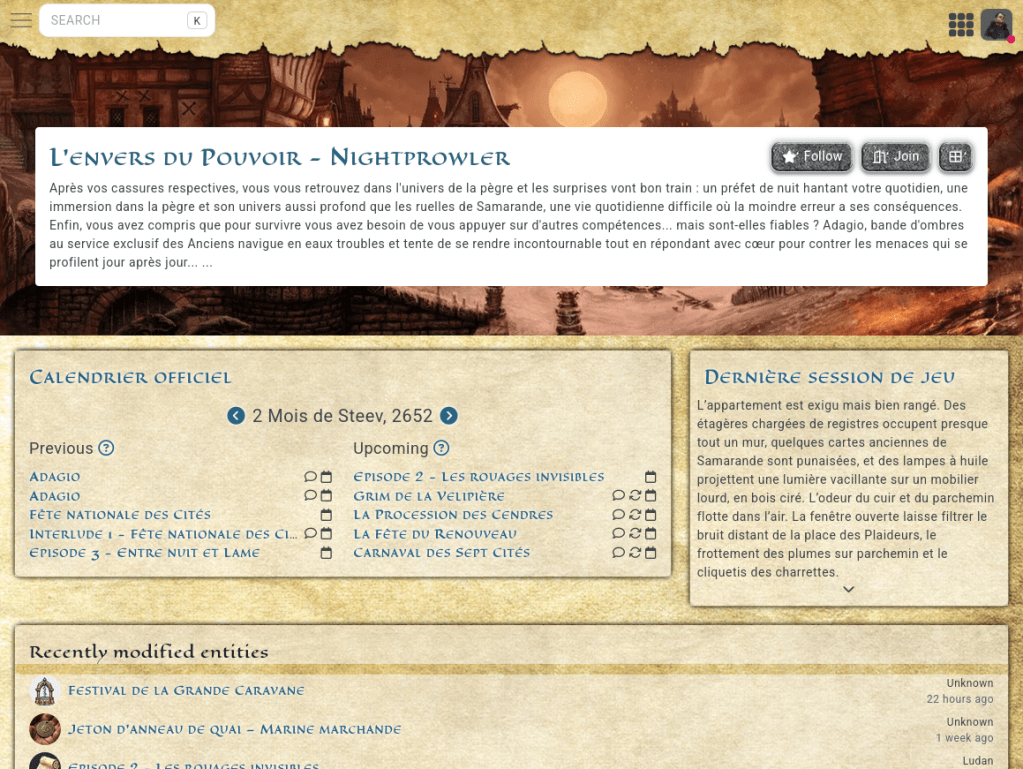
A quick note before we start: Ludan submitted his answers in French. “Luckily”, I’m a native French speaker, so the translation below is mine.
How long have you been building this world?
Since 2022, but what started as a simple campaign backdrop has grown layer by layer into something much larger: NPCs, districts, guilds, theologies, military hierarchies, criminal networks, family lineages, a port economy… At this point it’s less a game setting and more a living ecosystem. Every new plot thread reveals an older layer underneath.
What is this world really about?
Nightprowler is a world where you don’t save the world – you just try to survive in it. It’s a low-fantasy, urban, medieval setting that puts outlaws, thieves, assassins, and outcasts at the centre of the story rather than traditional heroes.
The action unfolds in a sprawling, cosmopolitan city – Samarande – where poverty, politics, the underworld, guilds, and the Church all compete for space.
At its core, the world is about power and its consequences: the power of the Law (corrupt, designed to protect the wealthy), the power of the Church (omnipresent, conservative, shaping belief and politics alike), and the power of criminal networks (offering those excluded from society an alternative path to influence and survival).
What are you most proud of?
Coherence. Every organisation has a complete hierarchy. Every district has an economic logic. Every cult has a structured doctrine. Every faction has interests that intersect and oppose one another.
But above all, I’m proud of my players. They don’t consume the world, they inhabit it. They make heavy, morally ambiguous decisions, and the world responds.
What inspires this world?
Historically, the world draws from medieval merchant cities, their layered port structures and centralised theocracies — places where commerce, faith, and politics intertwine in an unstable balance.
On the literary side, the setting leans heavily on the novels by Pierre-Henri Pevel set in the Nightprowler universe, published by Asmodée as the Chroniques des Sept Cités trilogy. These stories, set in Samarande, explore the inner workings, betrayals and tensions of a megalopolis where honour is measured as much by cunning as by the sword.
What kind of stories emerge at the table?
Stories of difficult choices, always. Nothing is simple, and nothing is free. Every decision pledges a loyalty, breaks a trust, or creates a debt. Alliances are improbable, fragile, and often temporary. Betrayals aren’t always cruel, sometimes they’re just necessary.
Characters climb the social ladder in a world that doesn’t forgive mistakes. Trauma resurfaces at the worst moment. Legacies you thought buried come back to collect.
It’s not a world where you save the world. It’s a world where you try to stop it from collapsing around you.
Why do you run games in Kanka?
Because Nightprowler is a long-running campaign structured like a real city: stratified, hierarchical, interconnected. That kind of complexity can’t live on scattered notes or approximate memory. It needs solid architecture.
Kanka is that architecture. Beyond the organisation, it enables something rarer: continuity. The campaign evolves. Characters age, change status, sometimes die. Alliances shift. Structures transform. And yet the world stays readable, searchable, alive.
Without Kanka, Nightprowler would be a good campaign. With Kanka, it’s a structured, lasting, organic universe.
We picked this one because it’s a reminder that Kanka isn’t just for dungeon-crawling. A gritty, politically dense urban world with 1,000+ entities and years of layered history are exactly the kind of project we had in mind when building the platform.
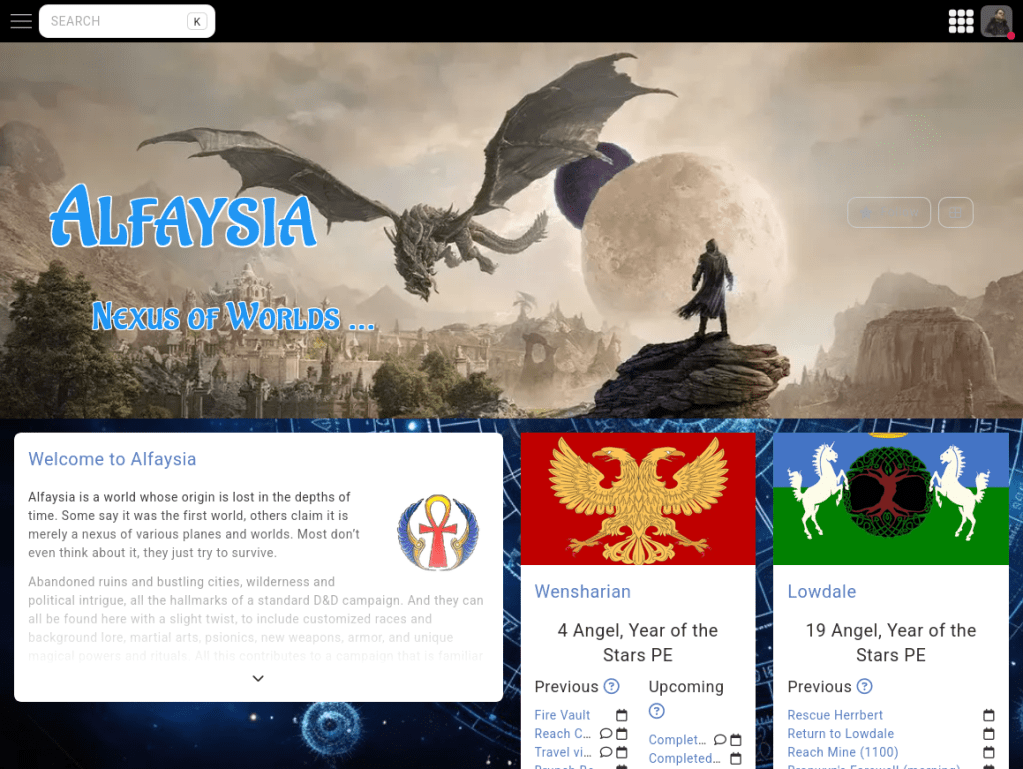
Alfaysia — SkidAce
How long have you been building this world?
Since 1987. What started as a local area based on the Greyhawk map slowly expanded into its own setting as locations and lore accumulated. A lot of the material still hasn’t been transcribed into Kanka. The backlog is real, and ongoing.
What is this world really about?
A sandbox built on ancient history and mythology, with an inordinate number of fallen empires scattered across it. The main setting picks up in the aftermath of a continent-shattering civil war that plunged everything into a long dark age. The surviving nations feel like they’ve recovered, they’re expanding again, but huge swaths of the world remain unexplored. The two largest powers, remnants of the original factions, are locked in a Cold War, skirmishing over territory and resources as they push outward.
What are you most proud of?
The coherence of the archetypes. Some of the nations are deliberately based on historical models. The Varencian Empire mirrors Rome, their rivals the Anguis Imperium draw from Turkish and Far Eastern concepts. That could easily produce a boring trope salad, but players over the years have said the archetypes actually help them get immersed faster. Apparently it worked.
What inspires this world?
Ancient history, mythology, classic fantasy novels, and older D&D adventures, with some newer ones thrown in.
What kind of stories emerge at the table?
Depends on the group. Early campaigns with military friends ran more like special operations. Rescue missions, toppling kingdoms, wilderness exploration. The most recent campaign has a druid-led group of anti-establishment adventurers fighting a lumber company that’s clear-cutting instead of harvesting responsibly. So: pretty standard stuff, and also very much not.
Why do you run games in Kanka?
Kanka hits the sweet spot between structure and freedom. Other tools felt constraining in how they let me present material. With Kanka I can use sidebar bookmarks, entity hierarchies, or clickable image maps — whatever serves the content. Templates and properties let me define exactly the fields I want for a given type of entry, without forcing me to fill in a wall of irrelevant ones.
Nearly 40 years of worldbuilding, 2,000+ entities, and still adding to the backlog. SkidAce’s campaign is a good example of what Kanka is built for: A living world that outlasts any single campaign and keeps growing.
Want to be featured?
The showcase is open to all campaigns, free or premium. If you’ve built something you’re proud of, apply on the showcase page. We’re looking for worlds with a story behind them: what they’re about, what drives them, what happens at the table. The writing doesn’t need to be perfect. The world just needs to be yours.
We go through applications at the start of each month. See you in #2.
 Kanka Blog
Leave a comment